


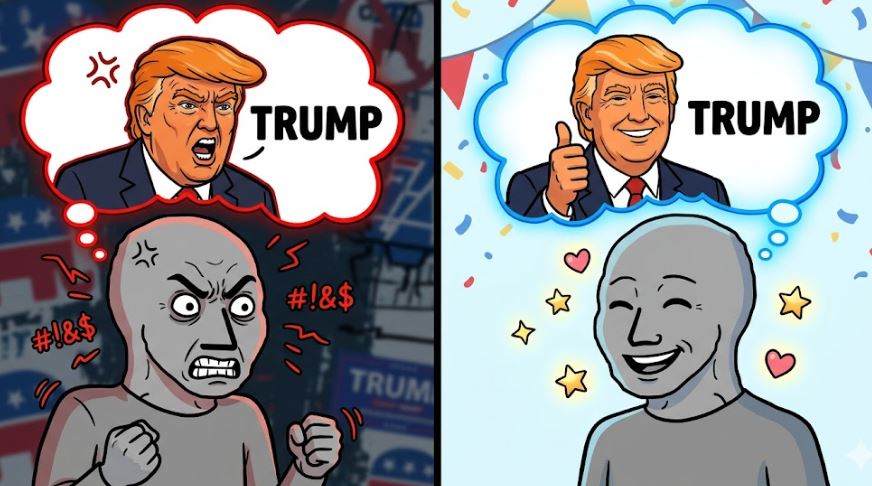
A Tale of Two Forms of TDS

If Trump Derangement Syndrome exaggerates faults, Trump Devotion Syndrome does the exact opposite. At the present moment, it may be the more dangerous of the two.
Probably my earliest recollection of Donald Trump was his cameo in Home Alone 2. Years later, I recall seeing fragments of the TV series The Apprentice. Unlike many others at the time, I found him too abrasive and impertinent.
Then came 2016. I watched several of his debates for the GOP leadership. I began to like his approach. What really caught my attention was the sloganeering of “draining the swamp,” opposing the “fake news,” and putting an end to “endless wars.” On November 9, 2016, I remember waking up deeply relieved that he won the presidency over Hillary Clinton.
Years later, I was upset about what appeared to me as blatant election fraud in the 2020 election. It was difficult to fathom how Biden attained the greatest number of votes in American election history. Despite all of this, I remained objectively rather skeptical of President Trump. I remember thinking that he was battling the political class and the globalists who control the financial system, which in turn influences culture, education, and many other aspects of society.
I even supported him and wrote some articles favoring his candidacy for the 2024 presidency. I had my reservations but remained hopeful. Once again, I was relieved, this time that Kamala Harris didn’t win. Over the years, I lost friends because of my public support of his policies and presidency.
He famously said over the years, and most recently during his 2024 election campaign: “They want to silence me because I will never let them silence you. They’re not coming after me, they’re coming after you. I just happen to be standing in their way and I’m never moving.” Well, he’s moved—far, far away from this position. Something has undeniably changed. Could it be he’s one of the ones that’s coming after you and that this was the plan all along?
In recent days, he’s displayed quite erratic behavior—much more than before. On Easter Sunday, on Truth Social, he threatened Iran to open the Strait of Hormuz with some expletives and closed by praising Allah. It was strange, but OK. Two days later, on April 7, he uttered more threats toward Iran: “a whole civilization will die tonight.”
Then, on Easter Sunday for the Orthodox Church, he posted an AI generated image depicting himself in the role of a healer: laying hands on the sick, radiating a divine-like power, with a disturbing, demonic figure lurking in the background. This, I believe, extends beyond poor judgment. It was a calculated and deliberate post. It places him into a role reserved for Christ alone, healing a man that, to many, resembles Jeffrey Epstein. This is blasphemous.
So it is becoming increasingly clear that Trump is not standing between the people and the elites at the center of the control system. For all intents and purposes, he has joined them or has made it clear where he always stood. He has even outpaced them. He now turns on the ones who were instrumental for his two elections. He attacks anyone who challenges him and supports those who once opposed him. The response to this major shift has revealed more confusion than clarity.
To be sure, not everyone has failed to recognize this transition, or perhaps unveiling. Some have been calling it out forcefully. However, the broader reaction falls into two camps, one familiar and one less often acknowledged. Both are equally distorting.
Trump Derangement Syndrome
Trump Derangement Syndrome is undeniably real. It has led many to interpret everything Trump does in the worst possible light, often ignoring his accomplishments or legitimate concerns. Now, to be clear, there are genuine examples of what can rightfully be called Trump Derangement Syndrome. Think of the mass hysteria surrounding the Russian collusion narrative and the subsequent impeachment efforts built upon it; or events like the Women’s Marches, the “No Kings” protests, and the all-too-common meltdowns following his elections and major policy decisions.
Many of his critics have reacted emotionally, with knee-jerk reactions, wishing harm and even death upon him. This extends far beyond political disagreement. It’s incivility like I’ve never seen before. A similarly grotesque reaction was seen in those celebrating the death of Charlie Kirk. However, in recent times, it has become a facile way to shut down any criticism, even when criticism is warranted.
I have experienced this firsthand. Because I have raised concerns about Trump’s recent actions, some friends—who fall into the “devotional” camp—have accused me of suffering from Trump Derangement Syndrome. This is not only false but also intellectually lazy. In jest, but not quite entirely, I have suggested that one of them suffers from LDS—Logic Derangement Syndrome. The other suffers from ideological possession; he even went so far as to claim that Trump is more Christian than Pope Leo (and he’s a Catholic, although lapsed).
Labeling someone as such functions similarly to the reflexive labelling we see throughout our culture. This is seen especially when disagreement is quickly dismissed with terms that have lost real meaning because of their overuse—labels such as “racist,” “homophobic,” “transphobic,” “Islamophobic,” and perhaps the most common today: “anti-Semitic.” These labels have come to replace the need to think. Now, these labels might be rightfully applied at times, but their overuse has had the opposite effect.
To call something what it is is not a derangement. It is discernment.
But there is another distortion, far less acknowledged but prevalent among devout Trump supporters. If Trump Derangement Syndrome exaggerates faults, Trump Devotion Syndrome does the exact opposite. At the present moment, it may be the more dangerous of the two.
Trump Devotion Syndrome
Trump Devotion Syndrome manifests itself through a kind of intellectual gymnastics, where contradictions are not confronted but reinterpreted, where they are not acknowledged but rather are framed as strategy. In any other context, this would raise serious concerns, but instead it is explained away as “5D chess,” media distortions, or the actions of rogue staffers.
We have witnessed this repeatedly. When challenged with blatant inconsistencies, some of Trump’s most staunch defenders insist that there is a deeper plan that we must trust, that he’s testing loyalties, that there’s a hidden strategy, a hidden move not yet revealed. This mirrors, in many ways, an unfalsifiable logic that once characterized movements like QAnon. If anything, it’s as if they’re taking notes from postmodernists who subvert truth.
Some have attempted to defend such imagery by appealing to Scripture—citing passages like Matthew 5:14-16 or the call to lay hands on others—in order to justify the blasphemous AI image. This is misguided. Christians are never depicted as Christ Himself. Believers may act in Christ’s power, but they are never Christ. The image crosses that line.
This pattern is reinforced by public defenders. Figures such as Alveda King, Dinesh D’Souza, Benny Johnson, and Roger Stone have downplayed or justified what would otherwise raise serious concerns. In some cases, such loyalty is not surprising given personal benefit, including presidential pardons. Loyalty is no longer measured by principle. It is now solely measured by unthinking compliance.
This is especially true on issues such as Israel and foreign policy. Those who dare question this narrative are quickly demonized. They are recast as disloyal or compromised. And all too commonly, they are dismissed as theologically illiterate for rejecting the assumptions of dispensationalism, a modern interpretive system that emphasizes a sharp distinction between Israel and the Church and has significantly shaped forms of Christian Zionism.
They are also likened to Islamic loyalists. If anyone accuses me of this, I invite them to read a comprehensive piece I wrote years ago on Christianity and Islam. I’ve also reviewed several critical books on Islam. I encourage friendship and collaboration with Jews, Christians, and others when possible—but not at the sacrifice of truth or one’s convictions, or to do so naively in the face of danger.
More sophisticated defenses reduce the issue of the blasphemous AI image to intention alone. While intent matters, it is not decisive. Blasphemy is not determined solely by what one claims to mean but by what is represented.
As the Catechism teaches, blasphemy includes “failing in respect toward him” and the “misuse” of what belongs to God (CCC 2148). Scripture likewise makes clear that we are accountable for what we express publicly, “for every careless word” (Matthew 12:36) and for the confusion we cause: “whoever causes one of these little ones…to sin” (Matthew 18:6). The issue, then, is not intent alone but what is publicly represented.
This is made even more implausible once we take into account Trump’s own explanation, where he claimed the image was simply of him as a “doctor” who is healing people. By reframing himself as a secular “healer,” Trump attempts to strip the image of its theological weight, yet this defense ignores how the visual composition, regardless of his stated intent, functions as a messianic appropriation that many believers find inherently blasphemous.
Trump’s words were merely a deflection that brought more confusion instead of clarity to his devoted followers. If we are to be seekers of truth, we must ask: what prompts were used to generate this image? If the intent were as innocent as claimed, there’d be no reason to withhold them. Without this type of transparency, the image must be judged by what it presents, not by what is later claimed.
This symbolic pattern is reinforced by how the imagery is being interpreted. Some commentators, including more speculative voices, have pointed to parallels with “magician” motifs, even referencing past remarks by Marina Abramović. Whether one accepts these interpretations is not the point. The imagery invites them.
This defense is further weakened by his recurring tendency to dismiss critics, and even his own supporters, rather than engage their concerns seriously. At its extreme, Trump Devotion Syndrome not only defends but absolves and sanctifies. It therefore crosses a dangerous line between political loyalty and cult devotion.
From Promise to Pattern: Accomplishment, Contradiction, and Betrayal
To be fair, Trump’s record is not devoid of any accomplishments. Indeed, a number of his policies reflect legitimate conservative priorities; and in several cases, they align with Christian concerns on life, family, religious liberty, and the human person. These include better efforts toward border enforcement, judicial appointments that reshaped courts, religious liberty protections, opposition to gender-affirming care policies, and broader policies related to family, education, and energy independence. Nevertheless, these accomplishments should not be taken in isolation. When we view them alongside recent developments, a different pattern begins to emerge.
Undoubtedly, when looked upon with a critical eye, there are a number of arising tensions that have complicated Trump’s relationship with his base. These include a concentration of ultra-wealthy figures, close ties to Big Tech highlighted by Trump hosting Sam Altman (OpenAI), Mark Zuckerberg (Meta), and Bill Gates, and a strange alignment with establishment and once-never-Trumper and chicken-hawk figures such as Lindsey Graham, Mark Levin, and Ben Shapiro, which demonstrates a major departure from his outsider posture. Recall that Zuckerberg was involved with rampant censorship of anything challenging the Covid narrative (something I’ve discussed at length in my book COVID-19: A Dystopian Delusion) and anything related to the 2020 election fraud.
These concerns are compounded by failures of transparency, particularly surrounding the Epstein files, and the absence of meaningful accountability for figures such as Anthony Fauci, Barack Obama, Hillary Clinton, and others associated with the “swamp.” Trump continues to praise Operation Warp Speed, despite overwhelming evidence raising serious concerns about the safety and efficacy of mRNA Covid vaccines. Public attacks on former allies and the stagnation of initiatives such as “Make America Healthy Again” only deepen the pattern.
In foreign policy, the recent escalation with Iran reflects a very troubling reversal from no “endless wars” to a myriad of justifications—whether humanitarian, strategic, opening the Strait of Hormuz (which was already open prior to the conflict), and economic—which are continuously shifting depending on the moment, echoing the very interventionist logic Trump once opposed. Taken together, these developments suggest not isolated missteps but a broader pattern of contradiction and repositioning.
This pattern extends to civil liberties. Support for measures such as Foreign Intelligence Surveillance Act (FISA) Section 702 (which allows warrantless surveillance of foreign targets’ digital communications), once criticized as tools of unlawful surveillance, now reflects the very expansion of state power that was previously opposed. It now makes perfect sense why he never pardoned Julian Assange or Edward Snowden.
What was once considered a unified movement is splintering every day. Figures such as Tucker Carlson, Candace Owens, Megyn Kelly, and Alex Jones, and politicians like Rand Paul, Thomas Massie, and Marjorie Taylor Greene, who were instrumental in his election, have all pulled away, especially after Trump’s harsh rebukes. Sadly, a movement that once prided itself on challenging power is now demanding undying allegiance to it. Ironically, the strongest opposition to Trump comes from the ones who supported him most loyally and staunchly.
At this juncture, we must ask ourselves: Who is Trump, really? Is he a reformer? A manipulator? A symptom of our spiritual blindness? A destroyer? Something worse? Or is it a combination of them? The answers to these questions may disturb some.
The symbolism did not start with the blasphemous image posted on Sunday, April 12; nor has it ended with it. The pattern and mockery continue. It appeals directly to Christian sentiment while distorting it. This is by design. Many do not realize that at his inauguration for his second presidential term, Trump did not place his hand on the Bible. Then, on April 15, he posted yet another image—rather than taunting Christians this time, he appears to appeal to them, portraying himself in intimate association with Christ.
Scripture warns that “Satan himself masquerades as an angel of light” (2 Corinthians 11:14). Deception does not come through lies alone but through a mixture of truth and lies. The ambiguity creates endless confusion.
As a Canadian, I look to the United States while facing our own financial and cultural decline under figures like Mark Carney. His alignment with global financial power and technocratic control reflects a parallel trajectory. It is no coincidence that these patterns converge across borders. It does not matter whether it comes from the “left” or the “right.”
We must be reminded: “Put not your trust in princes” (Psalm 146:3). Whether in Canada or the United States, the principle remains the same. Truth must stand above any tribe. Christ is always above politics. A movement that cannot distinguish between Christ and Caesar has already lost what it claims to defend.

Long diatribe. Not sure you’re having your own case of TDS.
The article critiques both forms of TDS. If that’s not clear, it’s worth another read.
Wow, it’s refreshing to finally hear you criticize this megalomaniac. But it’s funny how you attribute this to him changing. Right. If that makes you feel better. But the way I see it is that you are very naive.
All the shit going in the world and the stuff you choose to write about and focus on is just perplexing. You act like you have a monopoly over the use of logic. But I see your ability to synthesize information into big ideas as anything but logical. Why don’t you take a step back and engage in some serious self reflection. Therapy might be a helpful start.
You’re free to disagree with what I choose to write about, but that’s not an argument; it’s merely a preference.
If you think my reasoning is flawed, feel free to lay out a clear case.
I’m always open to substantive critique, especially when it comes from someone willing to stand behind it.
Speaking of which, anonymous criticisms are of the cheapest kind.
As for therapy, thinking about why you feel the strong urge to anonymously write comments like these might be worth some reflection.
You are welcome to keep checking out my story on Facebook as I publish more articles. I really appreciate the support. 🙂