


Deathbed Conversions and the Limits of Pascal’s Wager: Scott Adams and the Question of Authentic Faith

In Christian theology, salvation is not a bureaucratic threshold or an actuarial table. It rests on repentance, confession of sin, and genuine faith in Jesus Christ as Lord.
History is filled with stories of deathbed conversions. Some are reasonably well-attested, others disputed, and still others plainly legendary. Constantine delayed baptism until near death after a life marked by political power and violence. Oscar Wilde is often said to have received Catholic rites at the end of his life, a claim treated cautiously by biographers. Some accounts also suggest that Albert Camus engaged seriously with Christianity shortly before his death in a 1960 car accident, though this claim, drawn largely from a minister’s later testimony, remains debated.
Figures such as Rock Hudson, John Wayne, Gary Cooper, and Buffalo Bill are cited as documented late-life receptions into the Church, while unconfirmed or explicitly denied stories continue to circulate about David Bowie, the neo-atheist Christopher Hitchens, and the infamous satanist Anton LaVey, revealing how easily final beliefs are mythologized when they serve ideological ends.
But not every deathbed narrative points toward reconciliation. One often repeated account of Joseph Stalin describes him suddenly sitting upright and clenching his fist toward the heavens as if in defiance shortly before death. Although not an established historical fact, it functions well as an inversion of conversion narratives.
The oft-repeated line, “It’s great to live as an atheist but even better to die a Catholic,” commonly attributed to existentialist philosopher Jean-Paul Sartre, is not his but an urban myth born from this same unease. Sartre can be situated between these two extremities. In a 1980 interview with Benny Lévy, published in Le Nouvel Observateur and later collected in Hope Now, Sartre is quoted as saying:
I do not feel that I am the product of chance, a speck of dust in the universe, but someone who was expected, prepared, and prefigured. In short, a being whom only a Creator could put here; and this idea of a creating hand refers to God.
The statement flatly contradicts the core existentialist thesis that “existence precedes essence.” Simone de Beauvoir and others claimed that Sartre was senile and manipulated into saying something so heretical to the existentialist canon. Nevertheless, Sartre reportedly confirmed the authenticity of the interviews shortly before his death. What followed was not a conversion narrative but a cultural reflex. When belief emerges at the end of life, especially from a public skeptic, it is often explained away as weakness, fear, or incoherence. This is precisely the accusation Richard Dawkins leveled against the late Oxford atheist philosopher Antony Flew, who, while never converting to Christianity, affirmed the existence of God and remained open to the possibility of Christ’s divinity.
I suppose the lesson is that, in many cases, we are left sorting through misattributions, secondhand reports, or narratives imposed after the fact. Deathbed stories are often distorted by rumor, ideology, or the needs of those who survive the person in question. In rare cases, however, the record is unusually clear.
What makes a recent and widely discussed case different is precisely that we are not dealing with legend. We have recorded words and a written statement, offered deliberately and without evident pressure. The question, therefore, is not whether the words were said but what they signify and whether a conversion grounded primarily in calculation can bear the weight Christianity places upon genuine faith.
The Case of Scott Adams
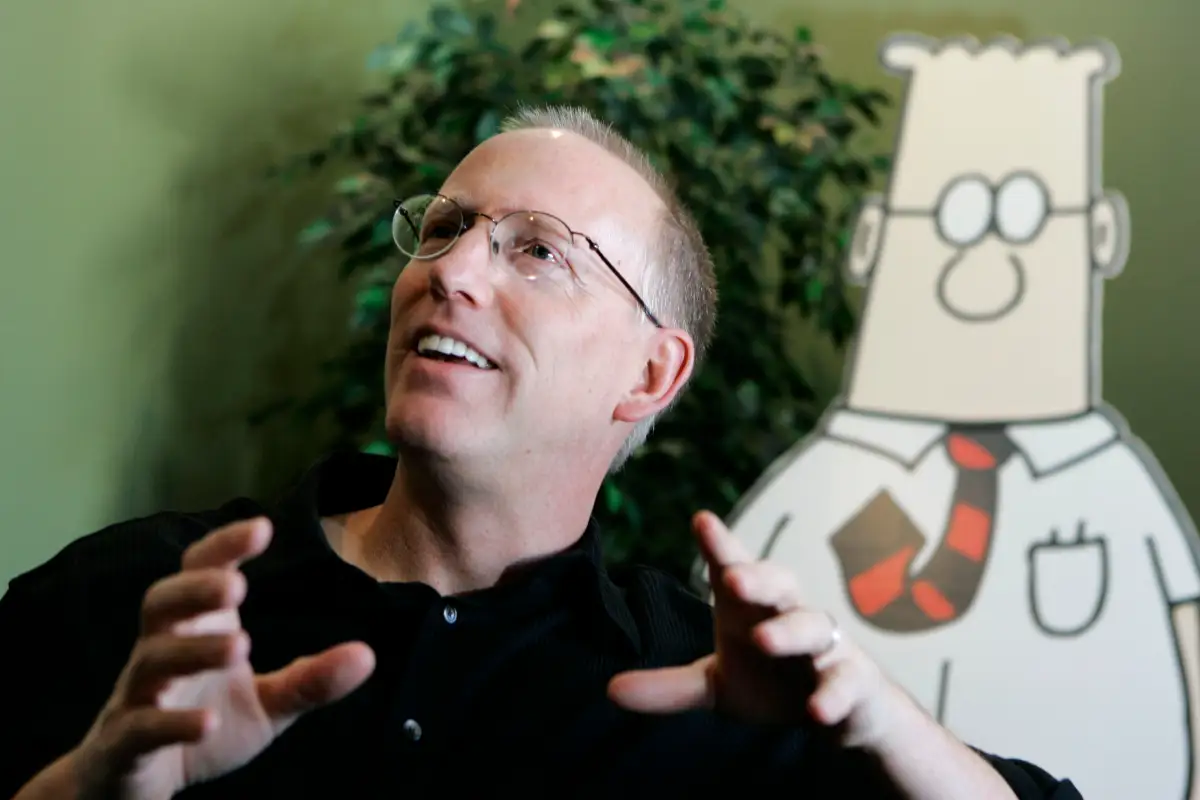
Scott Adams died after a year-long battle with prostate cancer. Best known as the creator of Dilbert, the satirical comic strip later adapted into an animated series. Adams, in his later years, became a public commentator, author, and podcaster, often exploring persuasion, psychology, and what he referred to as “the simulation.”
Shortly before his death, Adams recorded a message acknowledging persistent appeals from Christian friends to convert. In that recording, he stated plainly that he had not been a believer but that he respected Christians precisely because they attempted to convert him. He then announced that it was his plan to convert, adding that “you are never too late.”
His language was unmistakably pragmatic. If there is nothing after death, he loses nothing. If there is something, and Christianity is correct, he gains everything. He described this not as an emotional awakening but as a rational decision based on risk and reward.
After his death, Adams’ former wife read a final written message, dated January 1, 2026, in which he stated: “I accept Jesus Christ as my Lord and Savior and look forward to spending an eternity with Him…I hope I’m still qualified for entry.”
The statement was calm and deliberate. He affirmed soundness of mind, freedom from coercion, and absence of inappropriate influence. But the theological language was thin, cautious, and framed almost entirely in terms of calculation and qualification.
The phrase “I hope I’m still qualified for entry” is revealing. In Christian theology, salvation is not a bureaucratic threshold or an actuarial table. It rests on repentance, confession of sin, and genuine faith in Jesus Christ as Lord, who conquered sin and death decisively through the Cross and Resurrection.
Authentic conversion is not merely assent to a proposition nor acceptance of a favorable wager. It is a turning of the will, a reorientation of the self toward God. To be sure, Scripture does allow for last-minute repentance, most famously in the repentant criminal on the cross. Christianity has never denied the possibility of deathbed conversion.
But it has also insisted that God cannot be deceived. Words alone do not save. Calculation alone does not redeem.
Adams’ repeated emphasis on skepticism being “resolved if I wake up in heaven” subtly inverts the Christian order. Faith is not verification after death, but rather, it is trust before death. A provisional belief awaiting confirmation is indeed a dangerous proposition.
This does not allow outsiders to judge the soul. Only God knows the heart. But it does allow theological evaluation of the language used and of the model of belief implied.
Pascal’s Wager and Its Limits
This brings us inevitably to Blaise Pascal and Pensées, where the famous wager is articulated. Pascal argued that belief in God is rational because the potential gain is infinite and the potential loss is negligible.
Pascal never claimed the wager itself produced saving faith. It was a beginning, not an end. It was meant to move the will toward openness, prayer, and eventual encounter with truth—not to replace conversion with probability theory.
Pascal warned against a belief held only because it is advantageous rather than because of its truth.
Nowhere does Christianity teach that God rewards clever bets. Au contraire, God responds to humility, repentance, and love of truth.
Undoubtedly, there are perils to the glorification of deathbed conversions. We must be reminded that a lifetime of disbelief does not foreclose grace and that final meaning may not belong to the story others tell about a person.
It also serves as a temptation for believers toward triumphalism and skeptics toward dismissal. Both are errors.
The proper response is neither certainty nor cynicism but temperance. Only God knows what truly lies within the heart of every person. Authentic belief matters, and it cannot be reduced solely to calculation. While Pascal’s calculus may provide insight, it is insufficient to address the profound restlessness inherent in the human heart.
Scott Adams’ final words rest awkwardly between pragmatism and faith. Christ is acknowledged, but hesitation before Him persists. Salvation is invoked, but it is framed in terms of qualification rather than repentance or surrender. Whether that hesitation was overcome in ways unseen is not ours to know—and, still less, to judge.
What we can affirm, though, is that God is not mocked, but neither is He ungenerous with mercy. Deathbed conversions remain possible, but they are never mechanical. Although a wager may be rational, salvation is not reducible to a strategic bargain.