A Swish of Common Sense: Sophie Cunningham Strikes Again

Given the cost one pays as a public figure for taking a principled position against the prevailing zeitgeist, Sophie Cunningham's stance on women in women's sports is an act of heroic virtue.
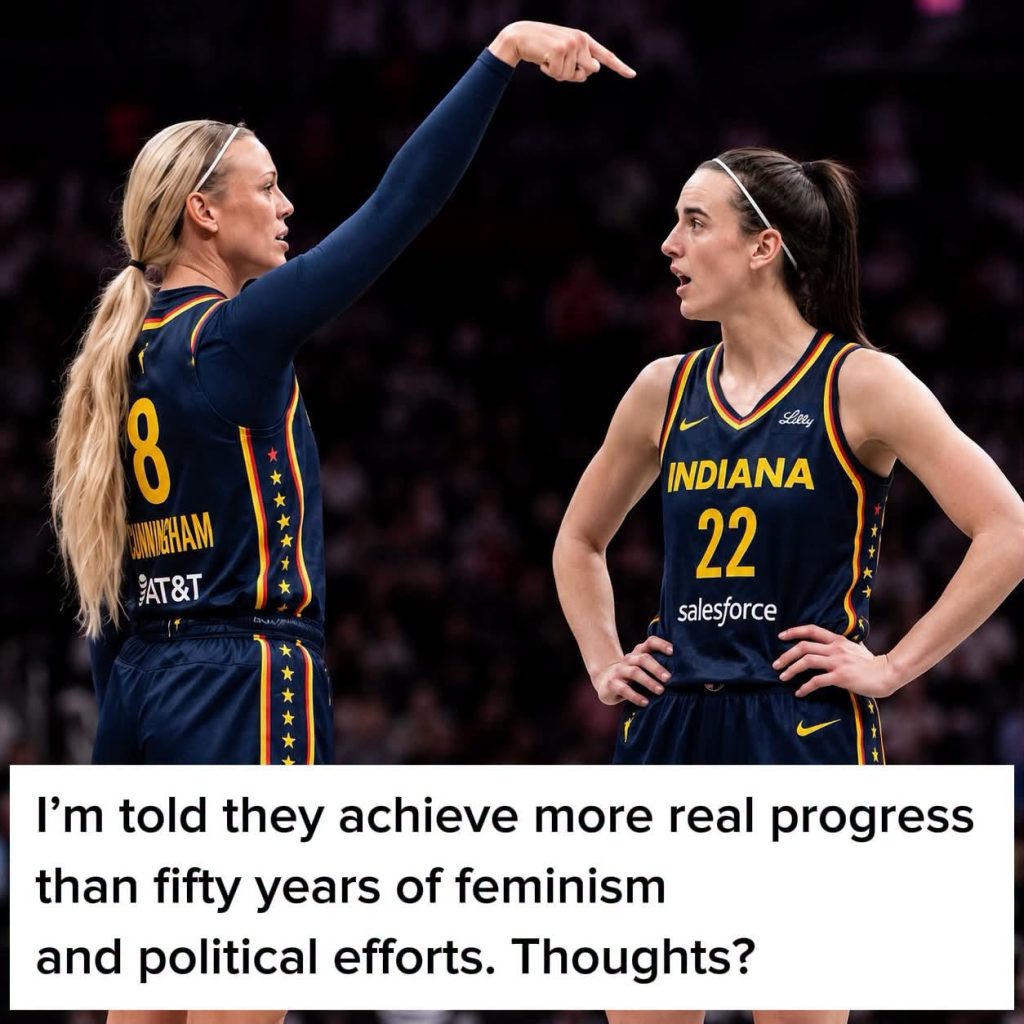
Just over a month ago, I wrote about Sophie Cunningham’s viral finger-pointing moment. I gave a philosophical and theological analysis of this cultural moment in women’s sports. I interpreted that seemingly silly gesture that captured the hearts and minds of many through the thought of Aristotle, Aquinas, René Girard, and Holy Scripture. What appeared to be a visceral reaction by Cunningham turned into something much deeper about friendship and combating injustice.
In the ensuing weeks, we have seen Cunningham increasingly willing to position herself against the prevailing culture—particularly of her own league, the WNBA—when she believes something important is true. Most recently, this has manifested itself in her defense of the commonsensical view that women’s sports should remain reserved for women.
From the many videos I’ve seen of Cunningham, whether on Facebook, YouTube, or 𝕏, it is evident that she has a very playful side. I would hardly consider her politically or ideologically motivated. In her own words: “I’m not a very political person, but I do have beliefs. I have morals and I’ll always stand on those and be true to who I am.” In fact, she has described herself as “very much in the middle” politically, explaining: “I agree with things on both sides, disagree with things on both sides. And that’s all I’ve ever said about my political beliefs. But people love to assume.”
Cunningham has been careful to distinguish her position on women’s sports from animosity toward transgender people:
I think that I am here to extend love. But I also think with that love is truth, being honest. And I want to protect young girls in a locker room, or young girls in sport who shouldn’t have to go against biological men.
Cunningham is absolutely correct to link truth with love; you can’t have authentic love without truth. Christ’s teachings and words precisely reflect this, regardless of how troubling they may sound to modern ears. When reporters subsequently pressed her on those remarks, Cunningham did not retreat: “I said what I said. I think it’s kind of common sense.” She added, “I think it’s really important to protect children, and that’s little girls who are also involved in that category.”
Cunningham then connected her position directly to the legal protections that helped make women’s athletics possible: “I think that’s why you have Title IX. That’s why you have some of the greats in women’s sports. If Title IX and women’s sports weren’t protected, then you wouldn’t hear about any type of women in sports.”
Cunningham is not alone. Tennis legend Martina Navratilova, one of the greatest female athletes of all time—and a longtime defender of “gay rights”—has, over the past few years, been very public about her defense of sex-based protections in women’s sports. Navratilova came out in defense of Cunningham on 𝕏, stating: “Sophie is not ANTI-TRANS—rather she is PRO-WOMEN!!!! Wrong headline!” in response to a caption with Cunningham’s picture: “Basketball’s new anti-trans MAGA poster girl.”
Navratilova also expressed deep frustration that more WNBA players, including Caitlin Clark, have not taken a similarly unequivocal position. Megyn Kelly called Clark cowardly for not speaking out in defense of women’s sports and her friend Sophie Cunningham. Nevertheless, the significance of Navratilova’s support should not be dismissed. The question of preserving women’s sports cannot easily be reduced to the old, tired political categories of Left versus Right. On this issue, Cunningham and Navratilova wholeheartedly agree that the female category in sport must mean something if the integrity of women’s sports is to be preserved.
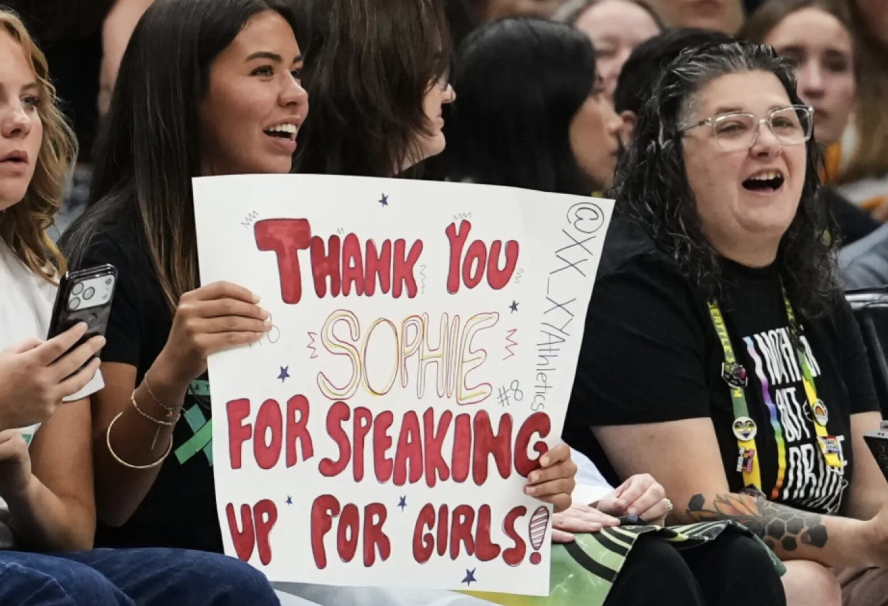
The controversy surrounding Cunningham extended beyond the players and public figures. At a Seattle Storm game against the Fever, two teenage girls held signs supporting Cunningham, including one that read, “Thank You Sophie for speaking up for girls!” Seattle Storm co-owner Celeste Keaton, upon seeing the sign, used profanity directed at them.
The incident was serious enough to prompt a public apology from the Storm. The WNBA fined Keaton and suspended her from attending five Storm home games. Cunningham praised the girls for standing up for their beliefs. Her response calls to mind the classic apologetics passage of 1 Peter 3:15, which reminds Christians that defending what one believes to be true should always be done with gentleness and respect.
Perhaps the most revealing development, however, has come from two former NBA players who have decided to test this logic themselves. Enes Kanter Freedom, a 6-foot-10 former NBA center, declared himself a prospect for the 2027 WNBA draft, stating: “If simply declaring who you are is all that’s required, then I meet every single requirement necessary to compete in the WNBA.” He insisted that he was not seeking to mock or disrespect anyone but rather asking that the rules “be applied equally, consistently, and without exception.” Former NBA player Royce White soon followed suit, declaring: “I’m transgender. I’m a woman. I identify as sometimes identifying as a woman for purpose of basketball, professional basketball, so I’ll be declaring for the WNBA draft in 2027 as well.”
Their words are deliberately provocative, but beyond the satire is a serious philosophical point. Close to 10 years ago, in a paper that grew out of a presentation I delivered at Ryerson University at the 2017 Canadian Jacques Maritain Association conference, I explored precisely this problem. The resulting paper, “The Deconstructing of Deconstructionism: Peterson Versus Derrida,” asked whether radical subjectivity applied to categories of identity ultimately leads to a reductio ad absurdum. If membership within an objective category can ultimately be determined by subjective self-identification, where does that principle stop?
Interestingly, I even used sports to illustrate the problem. I asked what would become of tennis if we dispensed with its defining categories and conventions: its net, rackets, balls, lines, scoring system, and rules. At some point, if everything defining tennis becomes arbitrary, we are no longer playing tennis. The same underlying question now confronts women’s basketball.
Drawing upon Aristotle and Aquinas, I defended the classical correspondence understanding of truth: our judgments are true insofar as they correspond to reality. Freedom and White are effectively testing the contrary proposition by pushing it toward its logical conclusion. If biological sex is no longer decisive in determining membership in the female sporting category, what objective criterion ultimately makes the Women’s National Basketball Association a women’s league?
Perhaps this is why Cunningham continues to resonate beyond the basketball court. Her positions are not the product of some elaborate political ideology but of something increasingly treated as radical: common sense. Whether defending a teammate, young girls, or the integrity of women’s sports, she seems willing to say what she believes to be true despite the consequences. In an age when conformity to falsehood can masquerade as virtue, defending reality can make one a heretic. In the world of common sense and truth, Cunningham is shooting nothing but net. Her latest cultural moment reminds us that sometimes courage begins simply by refusing to play make-believe.